

























Blog
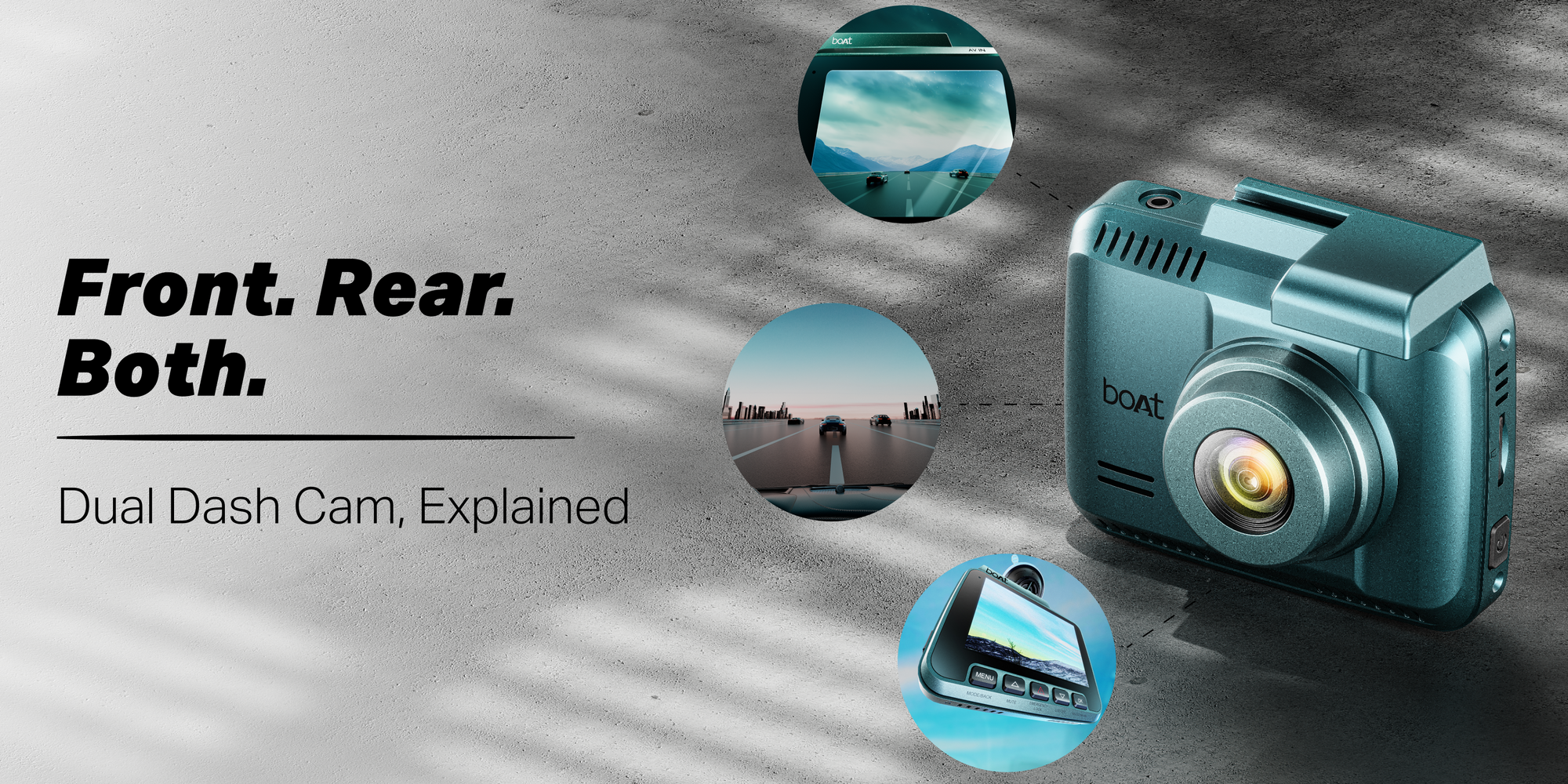
What is a Dual Dash Cam? Benefits of Front and Rear Recor...
We have all been there. You are stuck in bumper-to-bumper traffic, and the driver behind you is practically glued to your bumper. It’s stressful to say the least because one wrong move could mean an annoying, time-consuming fender bender when you’re probably already running late.
That’s the reason why many of us are opting to get a dash cam for car safety. And if you’re looking for one, you must have noticed two options: the standard front-facing camera and the two-camera setup. But what really is a dual dash cam, and does it actually make any difference? Let’s find out.
What Exactly is a Dual Dash Cam?
It’s exactly what it sounds like: a system with two cameras that record at the same time. The main camera sticks to your front windshield and records the road ahead. A second, smaller camera mounts to your rear glass and records whatever is happening behind you.
Both cameras connect to the same system, so your video files are saved to one memory card in the front unit. And you get a synchronised view of your entire drive.
Do You Really Need a Dual Dash Cam for Car?
Yes. While the front camera catches the obvious stuff, it only tells half the story. Having that rear angle matters because:
1. Rear-end bumps are super common
If someone bumps into your car from behind at a stoplight, the front camera only shows you jolting forward. A rear camera proves exactly who hit you and shows they weren’t paying attention, saving you from a massive headache with insurance.
2. The domino effect
Accidents are rarely simple. If a stray dog runs into the road and you slam on the brakes, the guy driving behind you might crash into your bumper. Having a dash cam for car that records both angles proves you stopped for a reason, not just to brake-check someone.
3. People back off
It’s almost funny how much better people drive when they know they are on camera. A visible rear camera often makes aggressive tailgaters back off and give you some space. This is especially common in urban areas, where people drive too close to you than you’d like.
4. Catch parking lot dents
Ever come back to your parked car to find a fresh scratch on the rear bumper? If your dash cam is wired to stay on while parked or comes with a G-sensor like our Hive Dashcam F1, it will catch exactly who backed into you and drove off.
Front-Only vs Dual Dash Cam: Who Wins?
Feature |
Front-Only Camera |
Front & Rear Camera Setup |
|
What it records |
Just the road ahead of you |
Both ahead of you and right behind you |
|
Parking protection |
Only watches your front bumper |
Watches both the front and rear bumper |
|
Proof in a crash |
Misses the rear-end details |
Shows the whole story from start to finish |
|
Installation |
Super quick, just plug it in |
Takes a little extra time to hide the rear cable |
What Makes the Hive Dashcam F1 the Best Dash Cam for Car?
If you’re looking for the best dual dash cam for car that does all the heavy work without being complicated to use, our Hive F1 is just what you need. See for yourself:
-
A front camera that records in 4K while the rear captures in 1080p
-
Sony STARVIS sensor for noise-free footage, even in the dark
-
ADAS alerts for forward collision, lane departure, and more
-
Built-in GPS that tracks routes, speed, and travel history
-
A G-sensor that automatically records emergency footage
-
App support with expandable storage up to 512GB
Wrapping Up
At the end of the day, finding the best dash cam for car security is all about making your life easier if things on the road (or parking lot) go wrong. A front-only camera is a good start, but a dual dash cam gives you real peace of mind. It takes a little time and effort to tuck the wire away for the rear camera, but the first time it saves you from paying for someone else’s mistake, you’ll be glad you have it.
FAQs
1. Do I need a dual dash cam for car if it mostly stays parked?
Absolutely! Mishaps in the parking lot are quite common. Having a dash cam that records both the front and rear can help you identify who crashed into your car and even assist with an insurance claim.
2. How to install a dual dash cam?
Start by mounting the front camera on your windshield and the rear camera on the rear glass, route the connecting cable through the car’s headliner, and power the unit via the hardwire kit.
3. Which is the best dual dash cam for car?
The boAt Hive Dashcam F1 is one of the best dual dash cams, as it offers a 4K front camera, 1080p rear camera, STARVIS sensor for night vision, built-in GPS for route logging, and ADAS alerts.
4. Does boAt offer any warranty on its dash cams?
Yes, boAt offers a 1-year warranty on its dash cam and the car charger. To claim the warranty, you must register your device on the official website.


