













Four o'clock, usually. That's when it happens.
Phone on 8%. Home is an hour away. The one cable you own is lying on your desk where you left it this morning. Someone at work lends you their charger, and of course it's the wrong pin. So for the next hour you ration your screen like it's 2009 and data still costs money.
A powerbank fixes this. No surprise there. The surprise is how many people pick the wrong one. Some buy the biggest mAh figure their budget allows and then lug a small brick around that never gets fully used. Others go for the slimmest one on the shelf, and it gives up before the phone does.
boAt's Apex range has four power banks, available in 10,000mAh and 20,000mAh capacities, with different charging speeds, connectivity options and form factors. They aren't four versions of the same thing. So there's no winner being crowned here. The idea is to figure out which one fits your day. .
First, the thing about "built-in cable"
Three of the four Apex models come with a built-in 2-way Type-C cable fixed into the body itself. Sounds minor on paper. In real life it isn't.
Count how often you've carried a fully charged powerbank and still been stuck, because the cable was at home. Full battery in your bag, dead phone in your hand, no way to connect the two. A cable that lives inside the powerbank removes that problem permanently. You cannot forget it, you cannot lose it, and nobody at the office can borrow it and walk off.
It is also 2-way, which means the same cable charges your phone and charges the powerbank itself. One cable for everything.
Honestly, if only one line from this sticks, let it be this one. For something you carry every day, the attached cable is worth more than a few extra watts.
Apex PB400: 20,000mAh Power Bank for Everyday Use
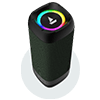
The Apex PB400 is a 20,000mAh power bank with a built-in 2-way Type-C cable and 22.5W fast charging in both directions, with QC 3.0, PD and PPS support, making it compatible with a wide range of smartphones and other USB-C devices.
Three outputs, so you can charge your phone through the built-in cable, a second device through the Type-C port, USB-A port, all together. That USB-A port is more useful than people expect. Earphones, fitness bands, the office trimmer, your father's old phone, a surprising amount of stuff still charges on USB-A.
The body has an anti-slip soft-touch finish with a glass top, so it does not slide off a car seat every time you brake.
Around Rs 2,199, in Noir Black and Storm Blue.
For most people, most of the time, this is the answer. Big enough for a full day of heavy use plus some, fast enough, and it charges everything.
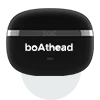
Apex PB400 Pro: smaller, smarter, one port less
Battery, speed and cable are all the same as the PB400. The Pro gets two additions. The body is noticeably smaller, and the glass top has a little digital display showing the exact percentage left.
The display sounds like a gimmick until you have owned a powerbank without one. Four little dots tell you almost nothing. A number tells you whether to charge it tonight or whether it will survive tomorrow.
Now the honest part. The Pro has two outputs, not three. It drops the USB-A port that the standard PB400 has. So the "Pro" is more compact and more informative, but it charges fewer devices at once.
If everything you own is Type-C, you will never notice. If you still have even one USB-A device, the standard PB400 is actually the better buy, and it costs Rs 400 less.
Around Rs 2,599, in Shadow Black and Nimbus Blue.
Apex PB445: 45W Power Bank for Tablets and USB-C Laptops
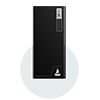
This is the fast one. 45W Turbo Fast Charging, two-way, with QC 3.0, Power Delivery and PPS.
45W is where a powerbank stops being only a phone accessory. Tablets charge properly at this speed, and so do some lightweight laptops that charge over USB-C. If you travel for work and your laptop charges through Type-C, check what wattage it needs. If it is 45W or under, this one can keep it going on a long train journey.
It also charges the powerbank itself much faster, which matters more than people think. A 20,000mAh battery at slow speed takes an entire night to refill. At 45W, it is back to full much sooner.
Same 20,000mAh, same built-in 2-way cable, three outputs including USB-A, same anti-slip body with glass top.
Around Rs 2,899, in Phantom Black and Tempest Blue.
Buy this if you carry more than a phone. If it is only a phone, the PB400 does the job and the extra speed will mostly go unused.
Apex PB332 MagnaCharge: no cable at all
Completely different idea from the other three.
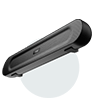
It has 10,000mAh, which is half of what the others carry. The trade is that it just sticks to the back of your phone with magnets and charges wirelessly at 15W. Nothing plugged in, nothing dangling while you scroll. You keep using it normally while it charges.
There is a built-in foldable stand, which is honestly the underrated part. Prop the phone up on a table for a video call or a cricket match while it charges. Once you have used it that way, a normal powerbank feels clumsy.
If your phone is not magnetic, boAt includes a free MagnaCharge Ring that sticks on and makes it work. It also does 22.5W wired charging when you want speed, through a Type-C port and a USB-A output.
Around Rs 1,999, in Noir Black, Storm Blue and Arctic White.
10,000mAh is a top-up rather than two full charges. Think of it as something that gets you from 30% to comfortable, not from dead to full twice. For daily use that is usually all anyone actually needs, and it is much lighter to carry around.
A few things the box will not tell you
The mAh on the box is not what reaches your phone. Part of it gets lost while the powerbank converts power for your device, so what you actually get is a fair bit lower than the printed figure. This is true of every powerbank from every brand. Plan on it and you will never be disappointed.
Speed depends on your phone more than the powerbank. Plug an 18W phone into a 45W powerbank and it still charges at 18W. The extra power just sits there, useful for laptops and tablets but not for an older phone.
Flying? Cabin bag only. Powerbanks are not allowed in checked baggage on Indian flights. Keep it in your hand luggage, and check your airline's current rules on using it during the flight, since several airlines now restrict that.
Charge it every few weeks even if you are not using it. A powerbank left completely empty in a drawer for months slowly loses capacity. Top it up once in a while.
Which boAt Apex Power Bank Is Right for You?
For everyday 20,000mAh use: Apex PB400.
For a compact 20,000mAh power bank with a digital battery display: Apex PB400 Pro.
For tablets or compatible USB-C laptops: Apex PB445.
For magnetic wireless charging and cable-free use: Apex PB332 MagnaCharge.
Explore the full Apex range at boat-lifestyle.com.


