













There is a moment most people have had with their earbuds, usually on a crowded road, where you say something perfectly clearly and the device does nothing at all. Or worse, does the wrong thing confidently. You repeat yourself. A rickshaw goes past. You give up and use the phone.
Audio hardware has improved enormously in ten years. Drivers, battery, noise cancellation, build quality, all of it genuinely better and much cheaper than it used to be. The intelligence inside barely moved. The earbuds got better at playing sound and stayed roughly as dumb as they always were.
That is the thing shifting now, and it has a name attached to it that is worth understanding properly before the marketing gets to it.
What is AI smart audio?
AI smart audio refers to audio devices that use artificial intelligence to understand and respond to what a user says, rather than only playing sound and responding to fixed commands. Instead of matching a spoken phrase against a short list of preset instructions, these devices interpret natural speech, hold context across a conversation, and carry out tasks like answering questions, translating languages or managing calendars and email by voice.
The short version: a normal wireless earbud is a speaker you wear. An AI smart audio device is meant to be something you talk to.
That distinction sounds like a marketing line until you use both. The old model was a list. Say "next", get the next song. Anything outside the list failed. The new model is closer to speaking to a person who understands you, including when you phrase it badly, change your mind, or ask a follow up that only makes sense given what you said ten seconds ago.
Was there not always a voice assistant in my earbuds?
There was, and this is where most of the confusion sits.
Older earbuds had a button that woke up whatever assistant lived on your phone. The earbud was a microphone and a speaker. It carried your voice to the phone and carried the answer back. It did not understand anything itself and it was not really part of the interaction.
Two things are changing. First, the intelligence is being built into the audio platform itself rather than borrowed from the phone. Second, the underlying models got considerably better at conversation, which is what makes a proper back and forth possible rather than a sequence of separate commands.
The practical effect is that the phone stops being the middleman for a whole category of small tasks. That is the real change, and it is worth more than it sounds.
What is Crest AI?
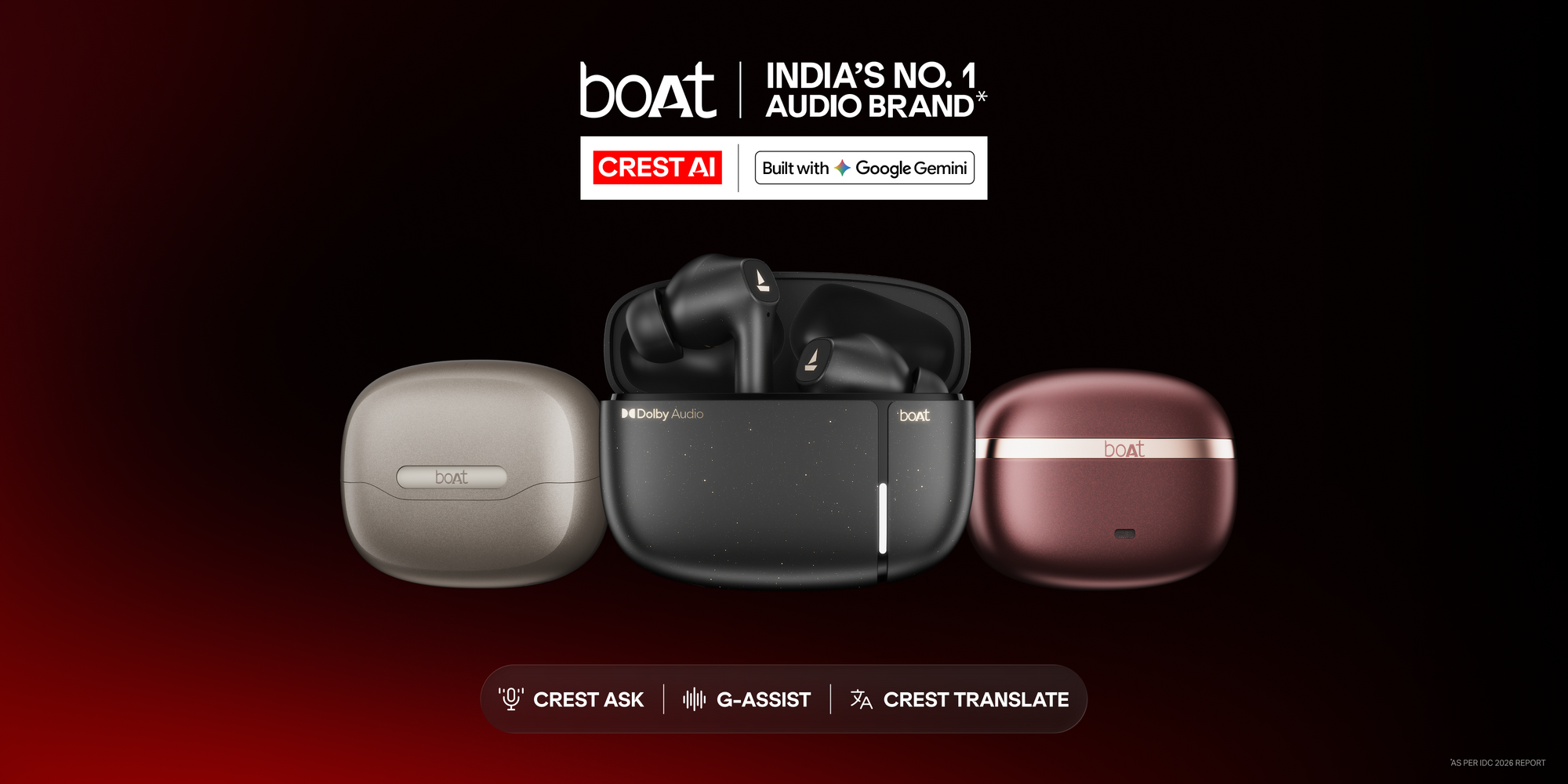
Crest AI is boAt's AI platform for its next generation of smart audio devices, built with Google Gemini through a partnership with Google Cloud. It uses Gemini Live to handle natural, conversational voice interaction on earbuds, headphones and speakers, and is designed to work across India's languages and regional dialects.
To be straightforward about what is boAt's and what is Google's, since the coverage has been a bit muddled on this point: Crest AI is boAt's platform, and the conversational intelligence inside it is Google's Gemini, running on Google Cloud infrastructure. Both parts of that sentence are true and the partnership was announced by both companies.
It is also worth being clear that no Crest AI device has launched. boAt announced the platform and its features. The hardware is still to come. Anything you read describing what it is like to use is describing the design, not a review.
What can it actually do?
The confirmed feature set breaks into three groups.
Conversation, through a feature called Crest Ask. Questions, learning about something, thinking an idea through, or simply talking, with the device holding the thread across follow ups rather than treating each sentence as a fresh start.
Translation, through Crest Translate. Real time and two way, including during calls, which is the part that makes it useful rather than a novelty.
Productivity, through Google Workspace. Gmail, Google Calendar and Google Tasks by voice. boAt's own examples are "Help me respond to that email" and "Schedule a meeting for me."
Alongside those, the platform covers general voice queries, device controls, music playback and product FAQ support.
Why does this matter more in India than elsewhere?
Because of how people here actually speak, and because of what the phone costs in attention.
Voice assistants have historically been built for clean, single language input. That is not how most conversation works in an Indian city. A normal sentence carries two languages, sometimes three, with the English word used for anything technical and the local word for everything else. Assistants have been consistently bad at this, which is a large part of why voice adoption stalled here despite the phones being perfectly capable.
boAt Crest AI is being built specifically against that problem. It is designed to handle regional dialects and the context around what someone means rather than only matching literal words. Google Cloud's India head has publicly framed voice and vernacular as the next frontier for AI in the country, and this partnership is aimed squarely at it.
There is a second reason, less discussed. A large number of people in India reach the internet primarily through a phone, often a shared one, often while doing something else. Typing is the bottleneck. Anything that removes the screen from a task removes a real barrier, not a theoretical one.
What is actually changing about how we experience audio?
Three things, in order of how much they matter.
The device stops being one directional. For the entire history of personal audio, sound went one way, from the device into your ears. You had controls, but you were not in a conversation with it. That changes when the thing can answer.
The phone leaves the loop for small tasks. Not for everything, and not soon for anything complicated. But the twenty times a day you take a phone out to do something that takes four seconds, that is where this lands.
Language stops being a wall. Two way live translation is the single feature here most likely to change something concrete in someone's day, whether that is a work call across states or sorting out a problem with someone you do not share a language with.
Frequently asked questions
What does AI smart audio mean? AI smart audio describes audio devices that use artificial intelligence to interpret natural speech and respond conversationally, rather than only playing sound and reacting to a fixed set of preset commands.
What is the difference between AI smart audio and normal wireless earbuds? Normal wireless earbuds play sound and support a small set of fixed touch or voice controls. AI smart audio devices understand conversational speech, keep context across follow up questions, and can carry out tasks such as translation, answering questions and managing email or calendar by voice.
What is boAt Crest AI? Crest AI is boAt's AI platform for its next generation of smart audio devices, built with Google Gemini through a partnership with Google Cloud, using Gemini Live for conversational voice interaction.
Is Crest AI available to buy right now? No. boAt has announced the Crest AI platform and its features. Devices carrying it have not launched yet.
Does AI smart audio improve sound quality? No. Sound quality is determined by drivers, tuning, fit and noise isolation. AI features change how you interact with the device, not how it sounds.
Does boAt Crest AI work without an internet connection? The conversational and translation features rely on cloud processing, so they need a connection. Standard audio playback is unaffected.
Which Indian languages does boAt Crest AI support? Crest AI is designed to work across India's languages and regional dialects, with contextual understanding rather than literal word matching. It currently supports 25 languages: English, Hindi, French, Japanese, Chinese, German, Portuguese, Vietnamese, Gujarati, Tamil, Marathi, Telugu, Malayalam, Bengali, Kannada, Dutch, Russian, Turkish, Korean, Polish, Thai, Indonesian, Italian, Spanish, and Arabic.