













Picture someone you probably know. Got their first smartphone maybe six or seven years ago. Has typed, in total, a few hundred words on it. Everything else happens by voice. Two-minute WhatsApp voice notes. YouTube searched out loud. And when they talk to the phone, they talk to it exactly the way they'd talk to a person, which is to say in Hindi, with English words dropped in wherever Hindi starts feeling like too much work.
"Sharma aunty wala paneer recipe nikaal do."
For years, that sentence broke things. The phone would catch the Hindi, mangle the English, or latch onto "recipe" and quietly give up on everything else. Then came the repeat, slower this time, louder, which never once helped anybody. And then the phone got handed to whoever was sitting closest.
Now it mostly works. Sounds like a small thing. It really isn't.
Voice isn't a "convenience feature" here
There's an assumption baked into a lot of product thinking: voice is for when your hands are busy. Driving. Cooking. Nice to have, sitting on top of the real interface, which is obviously the screen.
That logic falls apart in India.
The people coming online right now aren't going to graduate to typing and then abandon voice. Somebody who speaks a dialect at home, reads Devanagari slowly, and has never once opened a Hindi keyboard is not making that switch. Typing in your own language on a phone is still a genuine pain, which is exactly why half the country types Hindi, Tamil and Bangla in English letters and prays it lands correctly on the other side. Voice skips that whole mess.
Now put earbuds in the picture. No screen at all. On a device with no display, voice isn't one option among many. It's the only door in. If the voice model is good, the product feels good. If it isn't, there's nothing to fall back on.
Why this is much harder than "add more languages"
People underestimate this constantly. Including, sometimes, the teams building it.
Take Hindi. On paper, one language. In reality, Hindi in Lucknow, Hindi in Patna, Hindi in Indore and Hindi in Jalandhar are acoustically pretty different animals, and a model raised on clean Delhi-accented Hindi is going to flounder outside that bubble. Now do that for every major language in the country. It's not twenty-two languages. It's a few hundred ways of speaking twenty-two languages.
Then there's the mixing, which happens constantly and with zero warning.
"Bhai volume thoda kam kar, meeting hai."
Two languages, one sentence, switch happening mid-clause. Old systems wanted you to pick a language in settings and stay inside it like a good citizen. Nobody speaks like that. Fixing this needs models trained on how people actually talk, not two tidy monolingual datasets stapled together and hoped for the best.
Data is the other wall. English has decades of transcribed, labelled audio sitting around. A lot of Indian languages have very little. Some have almost nothing. Which is the deeply unglamorous reason Bhashini and the work coming out of AI4Bharat matter far more than they get credit for. Somebody has to lay that foundation, because otherwise every single company would be collecting data from zero, and no business case survives that for a language spoken by four million people. The maths just doesn't work.
And then names. Small issue, constantly overlooked. Station names, dish names, people's names. These wreck recognition systems more reliably than normal sentences do. "Chalo Thiruvananthapuram" or "Debjani ko call lagao" will break things faster than almost any standard command you can think of.
So what actually changed
Mostly the architecture.
The old way was staged. Audio to text, text to intent, intent to response. Every stage added its own errors, and those errors piled on top of each other, which is how you end up with a system that technically works and practically drives you up the wall.
Newer end-to-end models learn straight from audio, and it turns out they're far more forgiving about accents, half-finished sentences and mixed-language speech.
The second shift is that simple playback commands now run on the earbud itself. "Next song," "volume badhao," "call kaato," all of that happens locally, instantly, no server anywhere in the loop. The heavier stuff, actual questions that need reasoning or live information, still goes to the cloud. Anyone whose earbuds have gone silent inside a Metro tunnel has felt exactly where that line sits.
Where Indian brands come in
For a long stretch, the assumption was simple: the serious voice work happens abroad, Indian brands license whatever trickles down. That's changing,
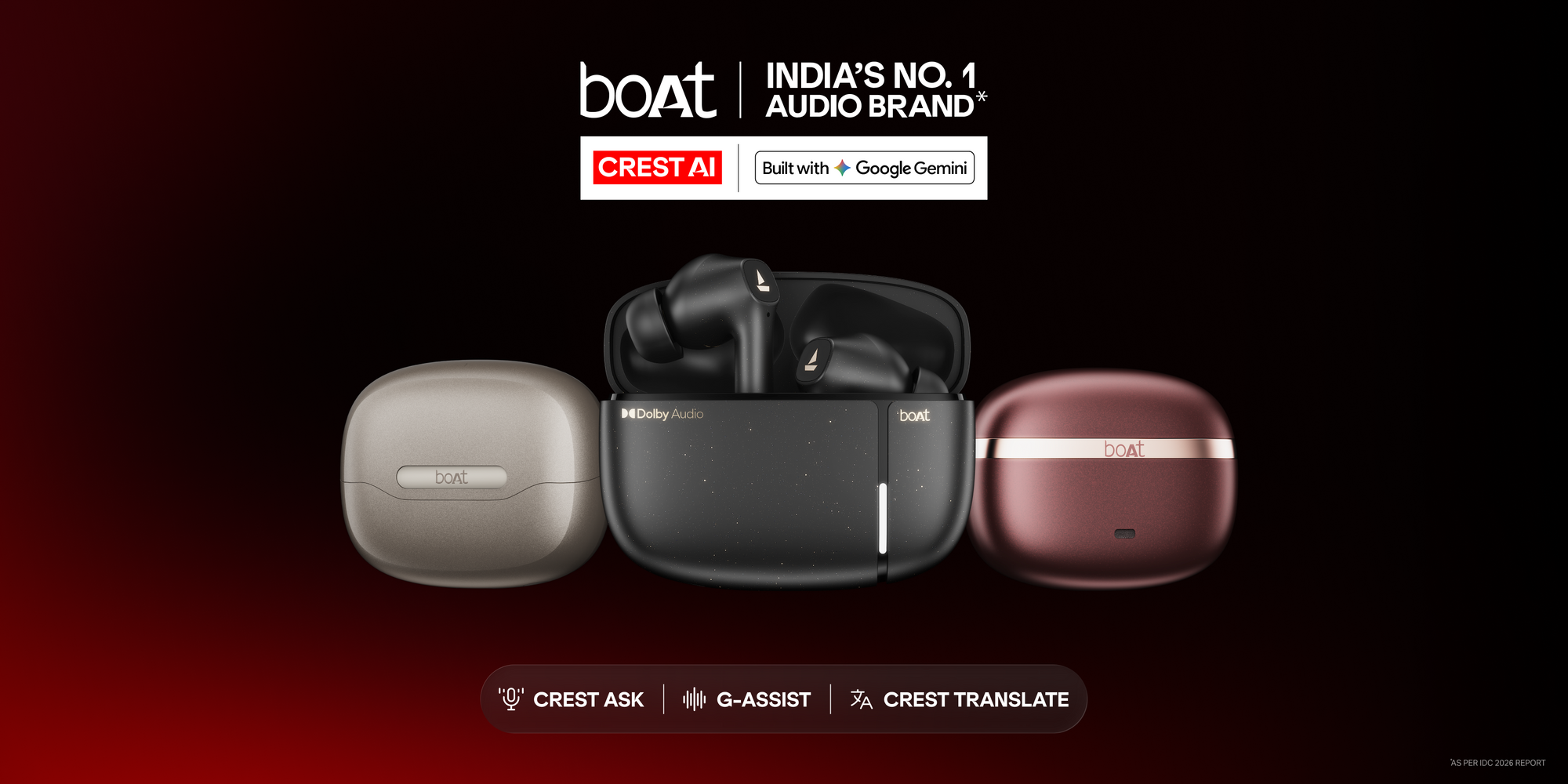
Crest AI is boAt's own AI platform, running on Google Gemini with Google Cloud doing the real-time speech processing, built to sit inside its next generation of earbuds and headphones. The pitch: earbuds stop being just music and calls and turn into something closer to a companion you happen to be wearing. Ask it things. Get live information. Get something translated or explained. All by talking, without digging the phone out every ten minutes.
Now, the honest bit, and it matters here more than in any other article about this product, because it's the exact thing this whole piece is about.
At launch, Crest AI listens in English only. Indian accents, foreign accents, both fine, but English. It isn't yet following the household that flips between Hindi and English mid-sentence. It isn't handling the accent that sits outside the training data. And it will not gracefully absorb "Thiruvananthapuram" dropped into the middle of a sentence. There's a translate feature, so you can ask it to give you a phrase in Hindi, but the listening side of the equation is still English.
That's not a footnote. If you're buying this specifically to solve the problem this article describes, that's the thing to know first.
To be fair, the direction is right, and full multi-language support looks like the obvious next step rather than a maybe. There's genuine logic in a homegrown audio brand doing this, boAt ships earbuds at a scale most global brands never touch in India, and building the hardware, software and AI layer together beats bolting an assistant onto whatever already exists. It's a better starting position than a global platform treating Indian speech as a support ticket. But better starting position is not the same as done, and any messaging suggesting otherwise is running ahead of the product.
Two more practical things. The conversational features need an active internet connection on your paired phone, so no offline mode there. And right now it's Android 12 and above only. Basic playback controls still work locally either way.
What to actually check before you buy anything
That "supports 10 Indian languages" line on the box? Test it. In your language. Out loud, in the shop, before paying.
Best test I know: deliberately give it a command that switches language halfway. If it handles that reasonably, it's a good system. If it needs you to commit to one language before you open your mouth, that's an old system wearing new marketing.
Don't judge it in a showroom either. Showrooms are quiet, which is not where you'll be using it. Step outside, stand near traffic, try again. Voice recognition falls apart in noise, which is why the mic array and noise separation matter as much as the language model does. These get listed as separate specs. They really aren't.
Check what still works without a network. Volume, playback, calls, none of that should need internet. If it does, the thing is heavily cloud-dependent, and you'll feel it the second your signal drops.
One last one people forget: some devices understand your Hindi perfectly and then answer you in English anyway. Technically working. Practically annoying.
It's still patchy, let's not pretend otherwise
Coverage is uneven. Big languages are served reasonably well. Smaller ones and most dialects aren't, and that gap isn't closing next quarter. Accuracy drops in noise, and drops further for older speakers, because their speech patterns are barely represented in most training data. Speak fast and things still fall over. Cloud delays can stretch long enough that people just give up and reach for the phone, which defeats the whole point.
Privacy is a real question here, not a paranoid one. A device listening for a wake word is, definitionally, listening. And a device you're meant to have conversations with, whether it's a global assistant or Crest AI or anything else, raises the same question. What's stored, what's sent, and how do you switch it off. You should be able to find that in the app in under thirty seconds. If you can't, that tells you something. On boAt's side, the stated position is that voice data is encrypted in transit and processed with your consent to deliver what you asked for, not sold off for third-party ads. Reasonable enough as policies go. Still worth reading the real policy instead of the tagline.
Here's the thing though. Nobody using their phone thinks about whether their sentence stayed grammatically consistent across two languages. Nor should they. People talk the way they've always talked, and the system either keeps up or it doesn't.
For most of the last ten years, it didn't. That part is finally changing, and for once, a chunk of that change is being built here. It's just not finished yet, and it's worth knowing exactly how unfinished.
FAQ
Does Crest AI understand Hindi and other Indian languages? Not at launch, no. Speech recognition works in English only right now, Indian and foreign accents both included. You can ask it to translate a phrase into Hindi as an output, but it isn't listening in Hindi yet, and it doesn't handle mixed Hindi-English sentences.
Why is voice AI so much harder to build for Indian languages than English? Three main reasons. Enormous accent variation inside a single language. Constant mid-sentence language switching that older systems were never designed for. And far less transcribed training data available compared to English, which is why groundwork from Bhashini and AI4Bharat matters so much.
Does Crest AI work without internet? The conversational AI features don't. Those need an active connection on your paired phone, and currently Android 12 or above. Basic controls like next track or volume run on the earbud itself and work fine offline.
How do I test a device's language support before buying it? Give it a command that switches language midway instead of a clean single-language one. Test it somewhere noisy, not just the quiet showroom. And check whether it replies in the language you spoke, plenty of devices understand you correctly and then answer in English regardless.
Is my voice data safe? boAt's stated position is that voice data is encrypted in transit and processed with user consent, used to deliver the feature you asked for rather than sold for advertising. That's a fair baseline. Still, check the app yourself to see what's stored and how quickly you can turn it off.
What are Bhashini and AI4Bharat? Initiatives building the foundational speech and language datasets for Indian languages that don't have decades of transcribed audio lying around. Without that base layer, most companies simply wouldn't find it viable to support languages spoken by smaller populations.
Will support for more Indian languages and dialects improve? Very likely, since end-to-end models already handle accents and mixed speech better than the old staged systems did. But today it's still uneven, and for Crest AI specifically, multi-language listening is on the roadmap rather than in your ears.